There are a few things you’d expect to see on a country’s money: founding figures, a king or queen, national landmarks, maybe a bit of historic symbolism.
What you wouldn’t expect is a full-blown theological declaration.
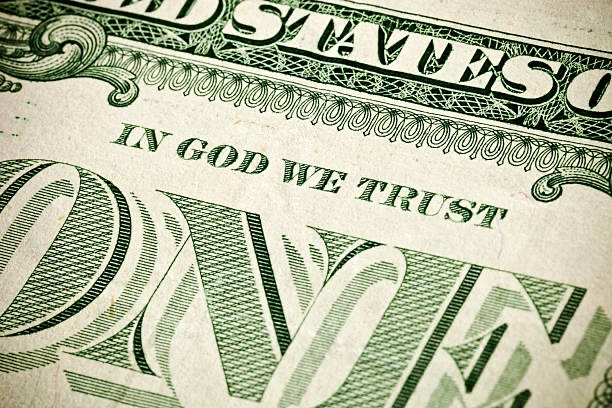
Yet, if you look at the almighty U.S. dollar bill, right there, bold as brass, is In God We Trust.
It’s a strange thing altogether.
So, in the 1950s, America, the land that prides itself on the separation of church and state, decided that every financial transaction should be legally blessed by the Almighty.
In fact, the US is the only “secular” state in the world that mentions God on their currency.
But how did that happen? And what does it tell us about a country that claims to be a democracy, yet insists on stamping a religious motto on the very thing that makes the world go round?
The Almighty Dollar
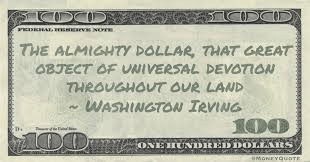
The expression, the almighty dollar, sums up the way money is treated in the U.S. As not just important, but almost sacred.
The phrase originated in the 19th century, coined by Washington Irving in 1837, and was used sarcastically to describe the way Americans seemed to worship wealth above all else. Over time, it became less of a joke and more of a cultural truth.
In the States, money isn’t just currency. It’s a marker of status, a measurement of success, and a supposed reflection of moral character.
If you have a lot of it, you must be doing something right. If you don’t, well, that’s probably a personal failing. This deep, almost spiritual reverence for wealth is what makes In God We Trust on money particularly ironic. By putting a religious endorsement right on the dollar, the U.S. effectively fused two of its greatest obsessions: capitalism and Christianity.
Which is weird because, as your Irish granny might have told you more than once, “money is the root of all evil”.

God and the Dollar: A Brief History.
If you assume that the founding fathers of the U.S. were all about this kind of thing, you’d be dead wrong. America was actually founded on the principle of religious freedom, which meant keeping government and God at a respectful arm’s length. The First Amendment makes it clear: Congress shall make no law respecting an establishment of religion.
For most of its history, the U.S. was content with a more secular approach to governance. But by the time the Civil War rolled around in the 1860s, the country was in such a state that religious leaders started campaigning for something to pull it back together. That something turned out to be a divine endorsement – first appearing on coins in 1864 as a sort of plea for national unity.
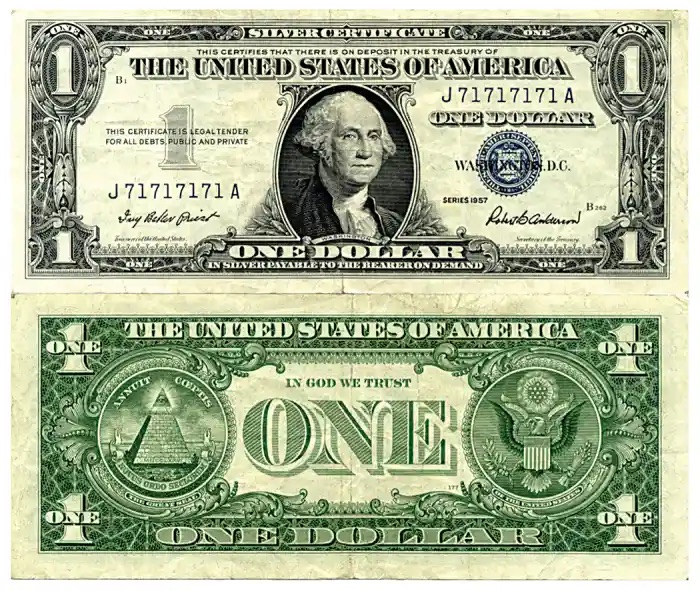
Fast forward to the 1950s, and America found itself in another existential panic – this time, terrified of the so-called “godless Communists” in the Soviet Union. To prove just how morally superior the U.S. was, Congress made In God We Trust the national motto in 1956 and slapped it onto all banknotes by 1957.
So there you have it: a nation allegedly built on religious neutrality, deciding -because of Cold War paranoia – to make faith a fundamental part of its financial system.
The Dollar as a Religious Artefact
The thing is, the one-dollar bill isn’t just a piece of currency. It’s practically a hymn sheet. Have a look at the symbols and phrases they’ve crammed onto it:
- The All-Seeing Eye & Pyramid
A giant, detached eye sits atop an unfinished pyramid – a nod to divine guidance, or perhaps just the ultimate Big Brother moment. The Latin phrase Annuit Cœptis means “He (God) has favoured our undertakings.” Subtle, right? - Novus Ordo Seclorum – The New Order of the Ages
This phrase sounds suspiciously like a threat, but it’s meant to celebrate the dawn of the American Republic.
- E Pluribus Unum – Out of Many, One
This was originally the national motto before In God We Trust elbowed its way in. It’s a far more inclusive message – one that actually reflects the country’s supposed diversity. - George Washington’s Side-Eye
The man himself, staring out at a country he probably wouldn’t recognise, given that he was big on religious neutrality. - And, of course, In God We Trust
Right there, on the front. A government-issued declaration that you have no choice but to carry around in your pocket whether you believe in it or not.

Why This is a Problem.
On the surface, some might say, “Ah sure, what harm? It’s just a phrase.” But it’s never just a phrase, is it? Especially not when it’s written on something as powerful as money.
It Blurs the Line Between Church and State
America loves to boast about its democratic ideals, yet the presence of In God We Trust on government-issued currency sends a clear message: faith (specifically, monotheistic, Judeo-Christian faith) is baked into the national identity. And once you start fusing religion with governance, things get murky fast.
Ireland, of all places, knows this lesson well. We spent decades trying to pry religious influence out of our legal system – from reproductive rights to education – because history has shown us the dangers of letting one belief system dominate a society. The U.S. hasn’t quite learned that lesson yet.
It Suggests That Capitalism is a Divine Mandate
There’s something deeply ironic about invoking God on money, as if wealth accumulation is a holy pursuit. It feeds into the particularly American notion that financial success is a sign of virtue, and poverty is a moral failing.
Ireland, on the other hand, has long had a more begrudging relationship with capitalism. We don’t tend to assume that the rich are inherently better people. If anything, we’re inclined to side-eye them and ask, “How did you get all that, then?”
It Excludes Non-Religious Citizens
Imagine being an atheist, an agnostic, or just someone who doesn’t want their government dictating their spiritual life – only to find that every single transaction you make carries a religious message.
The U.S. is home to millions of secular citizens, yet its government forces them to handle money that insists God is central to national identity.
In Ireland, we’ve been steadily stripping away the remnants of religious control, from removing church influence over schools to updating our constitution.
Meanwhile, America is still treating faith as a branding exercise.
It’s Performative More Than Anything
The reality is, In God We Trust doesn’t actually change anything. It doesn’t make society fairer, doesn’t reduce inequality, and certainly doesn’t ensure ethical governance. It’s a relic of a Cold War marketing campaign that, for some reason, no one’s had the nerve to take off the money.
So, What Kind of Country Puts God on the Money?
I have to admit, I’m deeply amazed to discover what all this reveals about what the world often sees: a young and super confident country.
It is, in fact, a country that’s deeply insecure.
One that claims to champion freedom while clinging to outdated religious nationalism.
One that mistakes branding for belief, and assumes that slapping a divine endorsement on currency somehow strengthens its moral authority.
And from where we’re sitting in Ireland? It’s the kind of country that still has a lesson or two to learn about what happens when you let faith and government share a bank account.
Maybe it’s time America trusted more in its people and principles—and a little less in the performative piety of its currency.
 Domesticky
Leave a comment