The British have never just ruled by force. That would be coarse.
And if there’s one thing the British go to great lengths not to be, it’s coarse.
Their true mastery lies in a different kind of warfare. One that doesn’t just require tanks or bullets, but also relies on a tangled web of bureaucracy, obfuscation and strategic inefficiency that really puts the divide-and-conquer strategy on steroids.
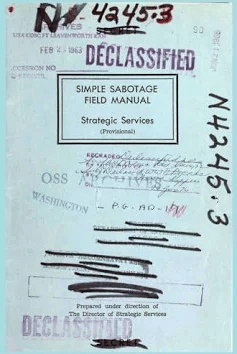
And if you were to look for an example that encapsulates this method of control, you need look no further than the Simple Sabotage Field Manual, a World War II document designed by the U.S. Office of Strategic Services (OSS) – now the CIA – to encourage resistance in enemy-occupied territories.
This handbook, originally meant to disrupt organisations from within, reads less like a manual for resistance and more like an instructional guide for British colonialism.
The very same strategies the OSS suggested to undermine enemy governments are the ones the British have perfected to maintain control over their colonies and former territories.
Here’s how they’ve deployed these tactics – strategically, intentionally, and repeatedly – across the world.

1. Bureaucratic Obstruction: How to Keep Colonies Too Busy to Fight Back
The Simple Sabotage Field Manual advises creating chaos in organisations by insisting on endless meetings, excessive procedures, and mountains of paperwork. British colonial rule elevated this to an art form.
Example: India – The Administrative Labyrinth
When the British ruled India, they didn’t just impose direct military control – they buried the country in an impossibly complex bureaucratic system. Every decision had to go through multiple layers of approval, every legal document required a mountain of signatures, and government positions were deliberately kept inaccessible to native Indians.
The result? A system so slow, so riddled with inefficiency, that no real opposition could effectively organise itself. And when independence finally came in 1947, Britain ensured India inherited a bureaucratic nightmare – one that persists to this day, clogging government functions and slowing progress.
Tactic: Make sure the colony is too busy filling out forms to organise resistance.

2. Divide and Conquer: The Ultimate Workplace Disruption
The Simple Sabotage Field Manual suggests that to create chaos in an organisation, foster resentment among co-workers, encourage disputes, and keep people distracted by infighting.
Again, the British did not just implement this strategy. They perfected it.
Example: Ireland – Catholic vs. Protestant
- Land policies were structured to favour Protestant landowners while pushing Catholics into poverty.
- Penal Laws were designed to systematically disenfranchise Catholics, ensuring constant resentment and class tensions.
- Partition in 1921 solidified the divide, ensuring the newly created ‘Northern Ireland’ remained a powder keg of conflict for the next century.
And when things got out of control? Britain conveniently stepped in as the “neutral mediator,” claiming to be the only force capable of maintaining order.
The firestarter plays firefighter.
Tactic: Keep the people so divided that they can never unite against you.

3. Economic Sabotage: Controlling the Supply Chain
The Simple Sabotage Field Manual suggests that resistance fighters should subtly disrupt production, slow down supply chains, and misplace key resources to create inefficiency. Britain applied this strategy on an imperial scale.
Example: The Bengal Famine – Weaponising Logistics
During World War II, Britain diverted food supplies from India to support the war effort, even as millions of Indians were starving. Winston Churchill, instead of offering relief, responded to the famine by deliberately halting shipments of grain, leading to the deaths of over three million people in the Bengal Famine of 1943.
This was not an accident. This was not bad policy. This was economic sabotage, ensuring that India remained too weak, too desperate, and too dependent on Britain to pose any real challenge.
Tactic: Control the flow of resources, and you control the people.

4. Controlling the Narrative: The Communication Breakdown Strategy
The Simple Sabotage Field Manual suggests spreading rumors, making vague reports, and delaying decisions to create confusion. The British did this not just within government structures, but on a global scale, ensuring that they controlled how history was written.
Example: Africa – The Erasure of Native Histories
In colonies across Africa, British officials actively destroyed local records, suppressed indigenous knowledge, and replaced history with their own version.
- They portrayed African societies as “primitive”, despite the existence of advanced civilizations like Great Zimbabwe, the Mali Empire, and the Kingdom of Benin.
- They downplayed their own atrocities, rebranding mass killings, forced labour, and land theft as “civilising missions.”
- They rewrote textbooks in former colonies to ensure that Britain’s crimes were conveniently forgotten.
Even today, British history lessons skim over colonial brutality, focusing instead on the “benefits” of empire.
Tactic: Control the story, and you control how history remembers you.

5. The Legacy of Sabotage: How Britain Still Uses These Tactics Today
Even as the British Empire has officially dissolved, its methods of control have not disappeared. These same strategies are still being used to destabilise nations, influence politics, and maintain global economic dominance.
- Endless bureaucracy still slows down economic growth in former colonies.
- Sectarian divisions still cause conflict in places where Britain ruled.
- Economic dependence still keeps developing nations tied to Western interests.
- History is still being rewritten to erase Britain’s crimes.
The Simple Sabotage Field Manual may have been written as a guide for resistance fighters, but for Britain, it reads like a policy doc or a job description. These tactics were never about “undermining the enemy”. They were about maintaining control, indefinitely, by keeping the world just chaotic enough to never pose a threat.
 Domesticky
Leave a comment