One American said that the most interesting thing about Holy Ireland was that its people hate each other in the name of Jesus Christ. And they do!
Bernadette Devlin
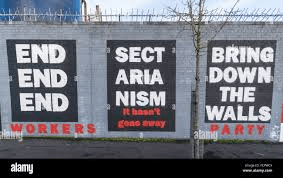
Sectarianism in Ireland isn’t Irish. It’s imported. It’s the English label slapped across an all-embracing people who never asked for a holy war. They just wanted their land, their lives, and their dignity.
The Irish didn’t invent sectarianism. Colonialism did.
What looks like ancient religious hatred is, in fact, a brilliant piece of imperial sabotage: a divide-and-rule policy dressed up as destiny. And it worked because it didn’t just divide the people. It rewired how they saw themselves.
A System Not a Spat
Let’s be clear from the get-go. The Irish – by nature, culture and history – are spiritual people. Not dogmatic, not exclusionary, and definitely not the kind to draw borders between souls. This is a culture that folds saints and spirits into the same breath. That welcomes pilgrims and poets with equal reverence. That baptised holy wells long before it baptised babies.
And yet, Ireland became the poster child for religious division. Why?
Because sectarianism was introduced as a control mechanism during colonisation and imposed like a curfew.
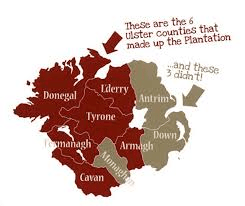
In 1609, the English Crown launched the Ulster Plantation, seizing lands from native Catholic chieftains and handing them to Protestant settlers.
It was a real estate heist dressed in religious robes.
The aim? Create a buffer of loyal Protestants in the most Gaelic, most Catholic, most rebellious corner of Ireland.
“Both the Protestant Unionists and the Catholic Nationalists deny they discriminate against each other, but both use religion to divide and rule the working class. It is only less serious on the Catholic side because there are fewer Catholic bosses and fewer Catholic local authorities in a position to practice discrimination. It is a tactic that has made the ruling minority look like a majority and has kept the Unionist Party in power since Northern Ireland’s inception. Polarised by this ploy into their religious sects, and set against each other, the ordinary people have not been able to combine and fight politically for their real interests.”
Bernadette Devlin
Sectarianism didn’t rise from the grassroots. It was poured in from the top, like weedkiller.
From the consolidation of English power in 1691 until well into the nineteenth century, religion was the gulf which divided the colonial rulers of Ireland from the native majority. This sectarian division resulted from deliberate government policy. It reached into political, economic, and personal life, through a series of statutes known as the Penal Laws.
By the 1700s, Catholics were locked out of land, law, education, and even inheritance. The Penal Laws were like a caste system in ecclesiastical drag. And Protestants who didn’t conform? They got the lash too.
It wasn’t about belief. It was about obedience. A religious apartheid engineered to benefit the colonial elite—and to keep everyone else distracted and divided.
Here’s the twist: sectarianism didn’t just crush Catholics. It conned Protestants.
Working-class Protestants were told they were better than their Catholic neighbours- but not so good they could threaten the elite. They were the loyal middle. The “chosen people” of a manufactured meritocracy.
As Devlin said:
“I had never hoped to see the day when I might agree with someone who represents the bigoted and sectarian Unionist Party, which uses a deliberate policy of dividing the people in order to keep the ruling minority in power and to keep the oppressed people of Ulster oppressed. I never thought that I should see the day when I should agree with any phrase uttered by the representative of such a party, but the hon. Gentleman summed up the situation “to a t”. He referred to stark, human misery. That is what I saw in Bogside. It has not been there just for one night. It has been there for 50 years – and that same stark human misery is to be found in the Protestant Fountain area, which the hon. Gentleman would claim to represent.
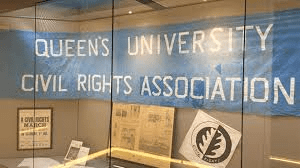
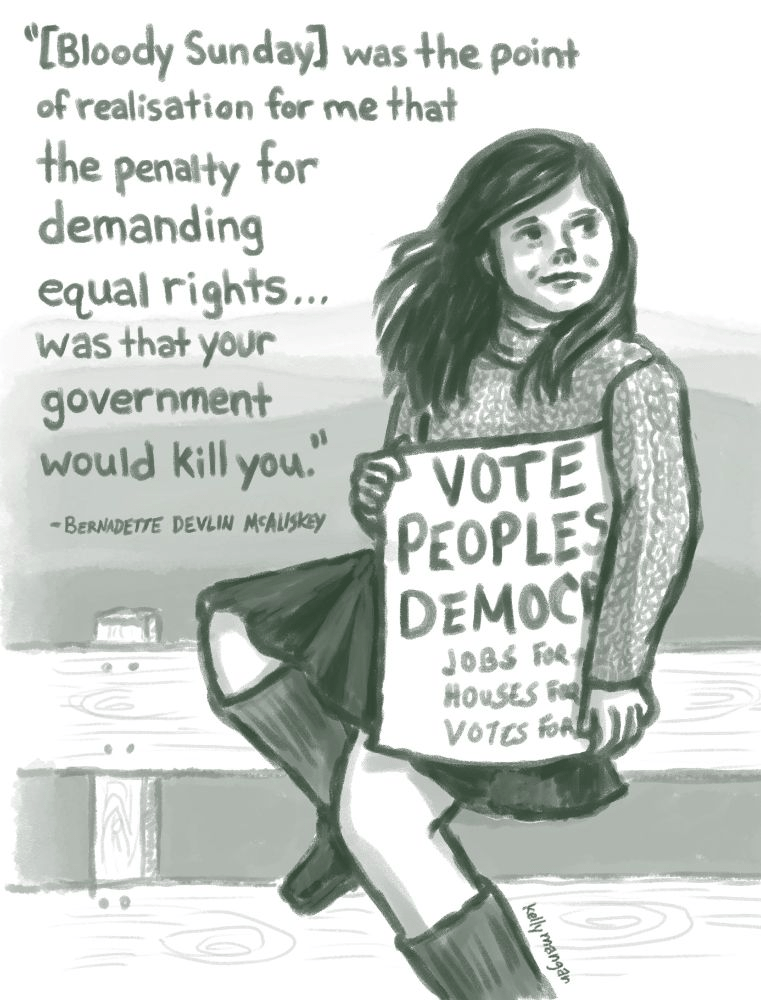
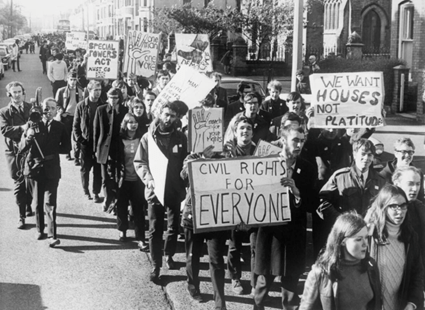
Fast forward to the 1960s, and the Civil Rights Movement in the North wasn’t about religion. It was about rights. About fairness. About jobs, housing, votes, and dignity.
But the system – clever and cowardly – repackaged it as a Catholic insurrection. That let them unleash batons on peaceful marches and still claim the moral high ground.
Devlin again:
This #SaintPatricksDay, I want to honor Bernadette Devlin McAliskey– imho, one the finest Irish civil rights organizers alive today. Bernadette has spent the last 50 years of her life fighting for civil & human rights in N. Ireland, and against British colonial rule. THREAD (1/11)
Sectarianism isn’t just cruel. if you look at it from a colonial point of view, it’s clever. It shifts blame. It obscures power. It makes ordinary people see enemies in each other instead of in the landlords, the law, or the lords.
It was so successful that even now, people believe the divide is ancient. Intractable. Religious.
It’s not. It’s engineered. And it’s still doing its job.
Mustachioed Mayhem: The Sectarian Spectacle of the 70s and 80s
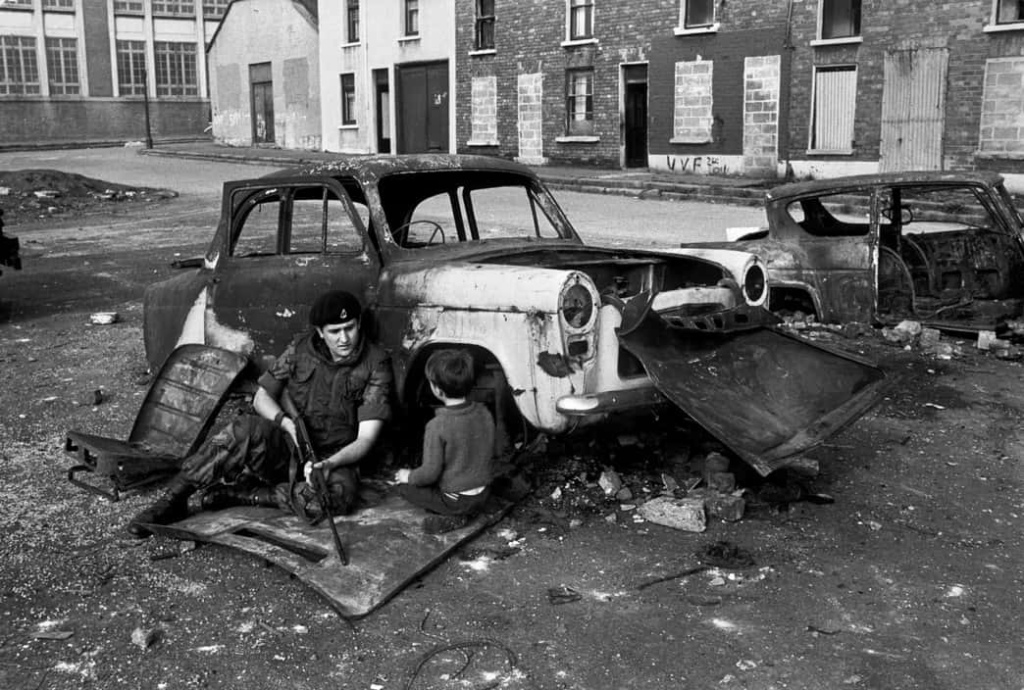
By the time the 1970s hit, Belfast had become the theatre of the absurd. Except the blood was real and the tickets were free.
Whole families were burned out of their homes for having the wrong name. Men were shot at breakfast. Children walked to school past bodies. And the world watched the North of Ireland with the same horrified fascination they reserve for footage of wild animals fighting over territory: primitive, savage, other.
But this wasn’t chaos. This was choreography.
The “pogroms” of the early 1970s weren’t spontaneous riots. They were ethnic cleansing on a local scale. Catholics were driven out of Protestant areas. Protestants were terrorised out of Catholic ones. Armed gangs roamed freely while the so-called security forces watched. Or joined in.
And through it all, the press reported on “tit-for-tat” killings, as if this were a lover’s spat gone wrong.
It wasn’t tit-for-tat. It was trauma-by-design.
And somehow, it all got framed as ancient religious warfare. Like these people couldn’t help themselves. As if Belfast had been cursed by God and not carved up by British policy.
Enter the moustaches. The men on the news. Mustachioed, middle-aged, and mad-eyed, they became the international face of the North: Shouting on the Shankill. Mourning on the Falls. Firing guns at funerals. Waving Bibles and flags with equal fury.
It was a global PR disaster. And still, no one said the quiet part out loud:
This wasn’t an Irish failure. It was a colonial one.
And it worked because who would believe the complexity of colonialism? Or that any country would really go to those lengths to distract from it’s cruelty?
The British media spun the chaos like a broken record: “Troublesome Catholics.” “Belligerent Protestants.” “Those people”
As if the Empire had no hand in the script.
No mention of gerrymandering. No exposé on MI5’s favourite loyalists. No reckoning with how British troops entered not as peacekeepers, but as enforcers of a rigged game.
It was the classic imperial playbook: light the match, then blame the fire on how flammable the furniture is.
To most Brits, Northern Ireland was a mess of its own making. A sectarian squabble that just happened to be happening on their doorstep.
Except the house was theirs. They built the walls. And they locked the exits.
“The BBC Broadcasting House based in Belfast had not escaped the sectarianism which pervaded this region. Established when the state itself was still in its infancy, BBC Northern Ireland was committed to upholding loyalty to British ideals. Senior staff in the Belfast branch maintained a close relationship to the unionist establishment for much of the twentieth century, and up until 1948 it was BBC policy to avoid debates around the constitutional status of Northern Ireland. Consequently, BBC Northern Ireland grew to be overly sympathetic to and representative of the Protestant unionist community, leaving many Catholics and nationalists to perceive this British broadcaster as something external, untrustworthy and unbalanced.”
That in pre-colonial Ireland, multiple spiritualities coexisted without crisis.
That our divisions were designed – carefully, consciously – by those who had everything to gain from our confusion.
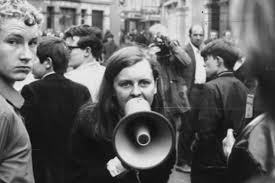
That Bernadette Devlin, a young woman in flares and fire, stood in Westminster and refused to let the system rewrite the story:
“At the bottom of the social pyramid with nothing to lose, the Catholic working man doesn’t really fear the Protestant; but the Protestant working man, who has very little, feels the need to hang on to his Protestant identity in case he loses what little he has. He fears the Catholic because he knows that any gain made by the Catholic minority will be his loss, for the businessmen and the landowners, Orange or Nationalist, are not going to suffer losses on anybody’s behalf. Where discrimination hurts most is in employment and housing.”
What Now?
We unlearn.
We teach our children that religion isn’t the problem. Weaponised inequality is.
We tell the truth about the plantations, the penal laws, the partition and the PR spin.
We reject both sides-ism that pretends the game wasn’t rigged.
And we remember: sectarianism was a tool. A strategy. A lie with staying power.
The Truth?
The Irish are not born sectarian. We were trained to be. Trained by a system that knew the power of unity—and feared it.
So here’s our job now: untrain the eye. Unlearn the story. Unearth the truth. Because the future of this island doesn’t belong to Orange or Green. It belongs to whoever dares to see beyond them.

 Domesticky
Leave a comment