There was a time when bombs in Belfast were front page atrocities on an international level.
Not because the British state had a sudden moral awakening about violence. No, it was because the violence was coming from the wrong side.
From Irish men and women who, pushed beyond the brink of patience and robbed of peaceful paths to justice, took up arms against a system that saw their humanity as negotiable.
They were demonised. Branded terrorists. Treated as if they were born bad, not shaped by a grotesque political reality in which civil rights were denied, homes were burned, and entire communities were policed in occupied, militarised zones.
British soldiers arrived in force, checkpoints split streets and cities, helicopters circled homes, and schoolchildren were frisked like suspects. Intimidation was the order of the day. The message was clear: the violence of empire is order.
The resistance to it? Chaos.
But now? Now the bombs are being built with profit in mind. The uniforms are corporate and the targets are global and the violence is no longer controversial. It’s needed. It’s wanted. It’s commodified. Branded. Celebrated.
In 2025 – this day and fucking age – bomb-making is no longer subversive or seditious – it’s a growth industry.
And Thales, a French arms company, is setting up its third facility in the North of Ireland, possibly right here in South Down but it’s hard to tell. They’re not that clear on the specifics.
This isn’t a fringe operation. Thales is a global player in the military industrial complex. Their war machines don’t just serve France – they sell to NATO, to the U.S. – to any regime with cash and a “security concern.”
Emma Little-Pengelly, the North’s Deputy First Minister, publicly commended the expansion:
“In global conflicts, the ability to defend oneself is absolutely critical.”
Global conflicts. Let that land.
This is no longer about local security or peacekeeping. This is full-throated participation in global war markets – exporting weapons from the same land that once begged for peace.
From a region that knows and has paid dearly for the cost of bombings, checkpoints, surveillance and state violence.

April 1941.
From Shorts to Thales: A Corporate Rebrand of War
To understand how we got here, we need to revisit the lineage.
Shorts Brothers, founded in 1908, was once a cornerstone of Northern Ireland’s aerospace industry. Based in Belfast, they built seaplanes, bombers and eventually missiles.
During the Second World War, Shorts was nationalised and became an essential cog in Britain’s war machine. Over time, they moved into aerospace and defence technologies.
In 1989, Shorts was acquired by Bombardier, who took on the civil aviation side, while the missile systems and weapons research division split off and eventually morphed through a series of mergers into what is now Thales UK.
Thales didn’t appear from nowhere. It’s the latest branding on a long-established structure – one that has always profited from war.
Its roots are in empire. Its operations are global. Its clients are whoever NATO can persuade to pay.
Today, Thales is part of the global military industrial complex – an interconnected network of private companies, government contractors, universities, think tanks, and lobbying arms.
It is designed to ensure that war is not only sustainable, but profitable. Forever.
It thrives on fear. On “defence budgets.” On new threats, new technologies, new markets. It makes sure there’s always a reason to arm up. To upgrade. To surveil. To strike.
And now, part of that machine is humming quietly away in County Down.
It’s worth noting that Thales is a French multinational, one of the largest defence contractors in the world.
This isn’t about local entrepreneurship or community – led innovation – this is about the seamless insertion of a foreign military corporation into the Irish landscape, dressed up in the soft-focus language of jobs and investment.
But that’s a story for another time.
The Jobs Mirage
“200 jobs.” That’s the PR hook.
That’s the justification for inviting an arms dealer into our community.
But what kind of jobs are these?
Let’s be real. Thales isn’t hiring your cousin who just left school or the neighbour retraining after redundancy.
These jobs require degrees in weapons engineering, cybersecurity, advanced AI and battlefield logistics. They involve clearance levels, military contacts, and ideological buy-in to the arms trade.
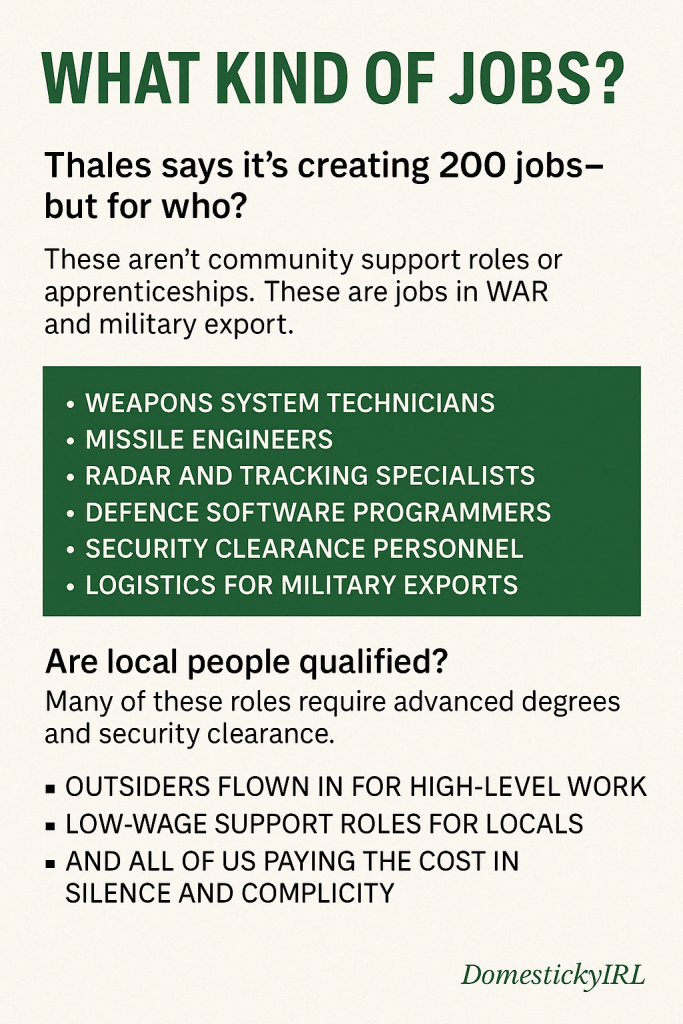
So, who are they for?
- Outsiders with elite qualifications.
- Defence contractors with connections.
- Local hires for admin, janitorial and low-level tech support.
It’s the same old trick: implement the economics of fear, throw the people crumbs, call it economic development.
The Academification of War
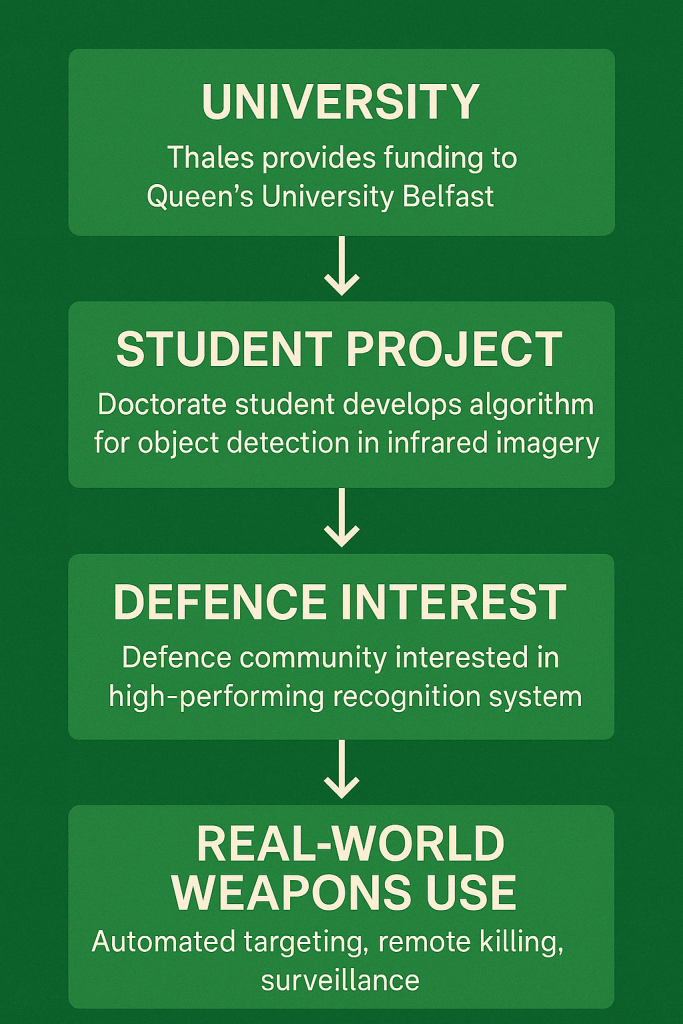
Here’s where it gets even stickier. In an effort to legitimise – efforts that clearly work – Thales funds students and research projects at Queen’s University Belfast.
This isn’t conspiracy – it’s proudly promoted on their site.
One PhD student, Rachael Abbott, is developing AI algorithms that help machines identify objects in cluttered urban environments using Long Wavelength Infrared (LWIR) sensors. What does that mean in plain English?
She’s training military systems to identify people in cities, at night, through walls and smoke – using less data and more automation.
This is surveillance tech with lethal applications. This is AI that can be embedded into drones, missiles, and autonomous war machines.
And it’s happening under the banner of “academic research.”
This is how modern warfare launders its morality: through partnerships with universities. Through the language of innovation. Through unsupervised learning models instead of body bags.
This is how war becomes polite. Respectable. Fundable.
Sell Me Slaughter: The Language of Marketable Violence
If you scroll through Thales’ website, you won’t see a single word that feels threatening.
They talk about:
- “Capability development”
- “Operational advantage”
- “Security solutions”
- “Autonomous systems”
War becomes a solution. Missiles become platforms. Drones become decision-making tools.
This is marketese. It’s the sanitised, blue-sky, business-class dialect of modern empire. It lets people sleep at night while machines carry out targeted killings. It allows politicians to cut ribbons at bomb factories without getting blood on their hands.
We used to whisper about bombs under our breath. Now they’re in funding applications, lecture halls and investment portfolios.
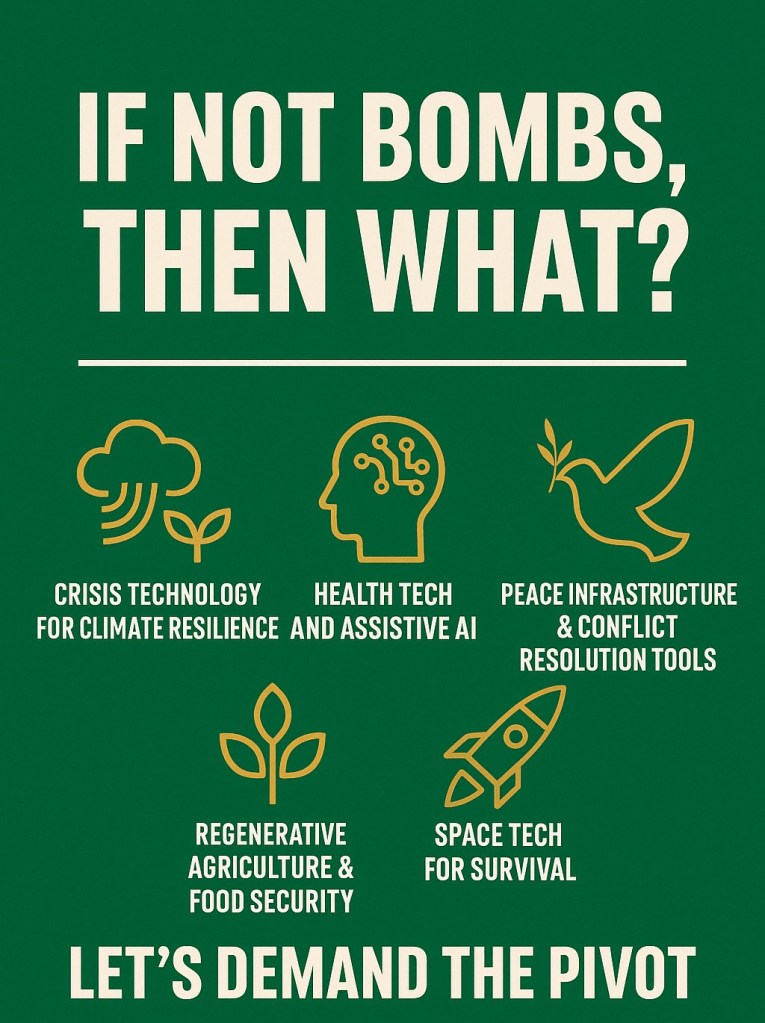
So What Could Thales Be Doing Instead?
Let’s imagine a pivot. Let’s take the billions, the engineers, the AI systems, the satellite links, and point them at life, not death.
🔀 Crisis Tech for Climate Resilience
- Infrared imaging for flood and wildfire prediction
- Drones delivering medicine to remote or flooded areas
- Heat-mapping to protect elderly people during climate events
🌾 Regenerative Agriculture & Food Security
- Soil sensor networks for sustainable farming
- Localised logistics tools for food resilience
- Autonomous tractors for small-scale farmers
🧠 Health Tech & Assistive AI
- Prosthetics using defence-grade mechanics
- Seizure-predicting wearable tech
- Visual AI for accessibility in public infrastructure
🌌 Peace Infrastructure & Digital Justice
- AI for de-escalation and conflict mediation
- Secure communication systems for activists and journalists
- Tech for reconciliation, truth commissions and historical archiving
🚀 Space Tech for Human Good
- Satellites for ocean plastic tracking
- Educational broadband networks via micro-satellites
- Crop health monitoring from space
Don’t Tell Us There Is No Alternative
We have the minds. We have the machinery. We have the money.
So why not choose peace? Why not demand that this place – South Down, the North, Ireland – stands for something better than conflict profiteering?
We’ve been bombed. Watched. Controlled. We know what state violence looks like.
Let’s not become the ones exporting it. Let’s be the ones who turned the factory floor into a field hospital.
Who took the heat sensors meant for missiles and used them to find elderly neighbours in danger during heatwaves.
Who turned targeting software into real-time flood prediction to keep families safe.
Who used drones not to kill, but to carry life-saving medicine across washed-out roads.
Let’s be the ones who used soil sensors to help small farmers grow food with less water and more wisdom.
Who took logistics built for war zones and applied them to local food systems so no family goes hungry.
Let’s be the ones who adapted AI to build prosthetic limbs, restore sight, and predict seizures.
Who taught machines not how to strike, but how to serve.
Let’s be the ones who turned surveillance into solidarity – building encrypted networks for activists, not armies. Who used satellites to track pollution, not people. Who launched tools for peace, not precision strikes.
Let’s be the place that proved a military budget could be a survival budget. That you don’t have to kill to be cutting-edge.
Let’s not build bombs in our backyard.
Let’s build a future worth defending.
 Domesticky
Leave a reply to MIC Drop – Domesticky Cancel reply